Race matters by Cornel West
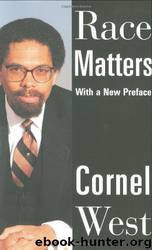
Author:Cornel West
Language: eng
Format: epub, mobi, pdf
Publisher: Beacon Press
In addition, Loury's rejection of blind loyalty to the race is laudable, yet he replaces it with a similarly blind loyalty to the nation. In fact, his major criticism of black liberals and left-liberals is that they put the black community out of step with present-day conservative America because they adopt an excessively adversarial stance to the rest of the country. This criticism amounts not to a deepening and enriching of black intellectual exchange but rather to a defense of new kinds of restrictions in the name of a neo-nationalism already rampant in America—a neo-nationalism that smothers and suffocates the larger American intellectual scene. In this way, Loury's neo-conservatism enacts the very "discourse truncation" he claims to be opposing in his foes. His frequent characterizations of left-liberal views as "anachronistic," "discredited," and "idiosyncratic," without putting forth arguments to defend such claims, exemplify this "discourse truncation."
Loury's halfway-house position between the black conservatism of Thomas Sowell and traditional black liberalism is symptomatic of the crisis of purpose and direction among African-American political and intellectual elites. Three fundamental processes in American society and culture since 1973 set the context for grasping this crisis: the eclipse of U.S. economic predominance in the world; the structural transformation of the American economy; and the moral breakdown of communities throughout the country, especially among the black working poor and very poor.
The symbolic event in the decline of American economic hegemony was the oil crisis, which resulted principally from the solidarity of the OPEC nations. Increasing economic competition from Japan, West Germany, and other nations ended an era of unquestioned U.S. economic power. The resultant slump in the American economy undermined the Keynesian foundation of postwar American liberalism, that is, economic growth accompanied by state regulation and intervention on behalf of disadvantaged citizens.
The impact of the economic recession on African-Americans was immense. Not surprisingly, it more deeply affected the black working poor and very poor than the expanding black middle class. Issues of sheer survival loomed large for the former, while the latter continued to seize opportunities in education, business, and politics. Most middle-class blacks consistently supported the emergent black political class—the black officials elected at the national, state, and local levels—primarily to ensure black upward social mobility. But a few began to feel uncomfortable about how their white middle-class peers viewed them. Mobility by means of affirmative action breeds tenuous self-respect and questionable peer acceptance for middle-class blacks. The new black conservatives voiced these feelings in the forms of attacks on affirmative action programs (despite the fact that they had achieved their positions by means of such programs).
Download
This site does not store any files on its server. We only index and link to content provided by other sites. Please contact the content providers to delete copyright contents if any and email us, we'll remove relevant links or contents immediately.
| Anthropology | Archaeology |
| Philosophy | Politics & Government |
| Social Sciences | Sociology |
| Women's Studies |
Cecilia; Or, Memoirs of an Heiress — Volume 1 by Fanny Burney(32558)
The Great Music City by Andrea Baker(32018)
Cecilia; Or, Memoirs of an Heiress — Volume 2 by Fanny Burney(31956)
Cecilia; Or, Memoirs of an Heiress — Volume 3 by Fanny Burney(31941)
We're Going to Need More Wine by Gabrielle Union(19046)
All the Missing Girls by Megan Miranda(16027)
Pimp by Iceberg Slim(14506)
For the Love of Europe by Rick Steves(14121)
Bombshells: Glamour Girls of a Lifetime by Sullivan Steve(14075)
Talking to Strangers by Malcolm Gladwell(13370)
Norse Mythology by Gaiman Neil(13363)
Fifty Shades Freed by E L James(13240)
Mindhunter: Inside the FBI's Elite Serial Crime Unit by John E. Douglas & Mark Olshaker(9342)
Crazy Rich Asians by Kevin Kwan(9292)
The Lost Art of Listening by Michael P. Nichols(7506)
Enlightenment Now: The Case for Reason, Science, Humanism, and Progress by Steven Pinker(7313)
The Four Agreements by Don Miguel Ruiz(6765)
Bad Blood by John Carreyrou(6621)
Weapons of Math Destruction by Cathy O'Neil(6279)
